Air turbulence explained: what creates bumps in flight?
A practical, source-led guide to the atmosphere behind a bumpy flight, the signals pilots use, and the difference between an uncomfortable ride and an unsafe one.
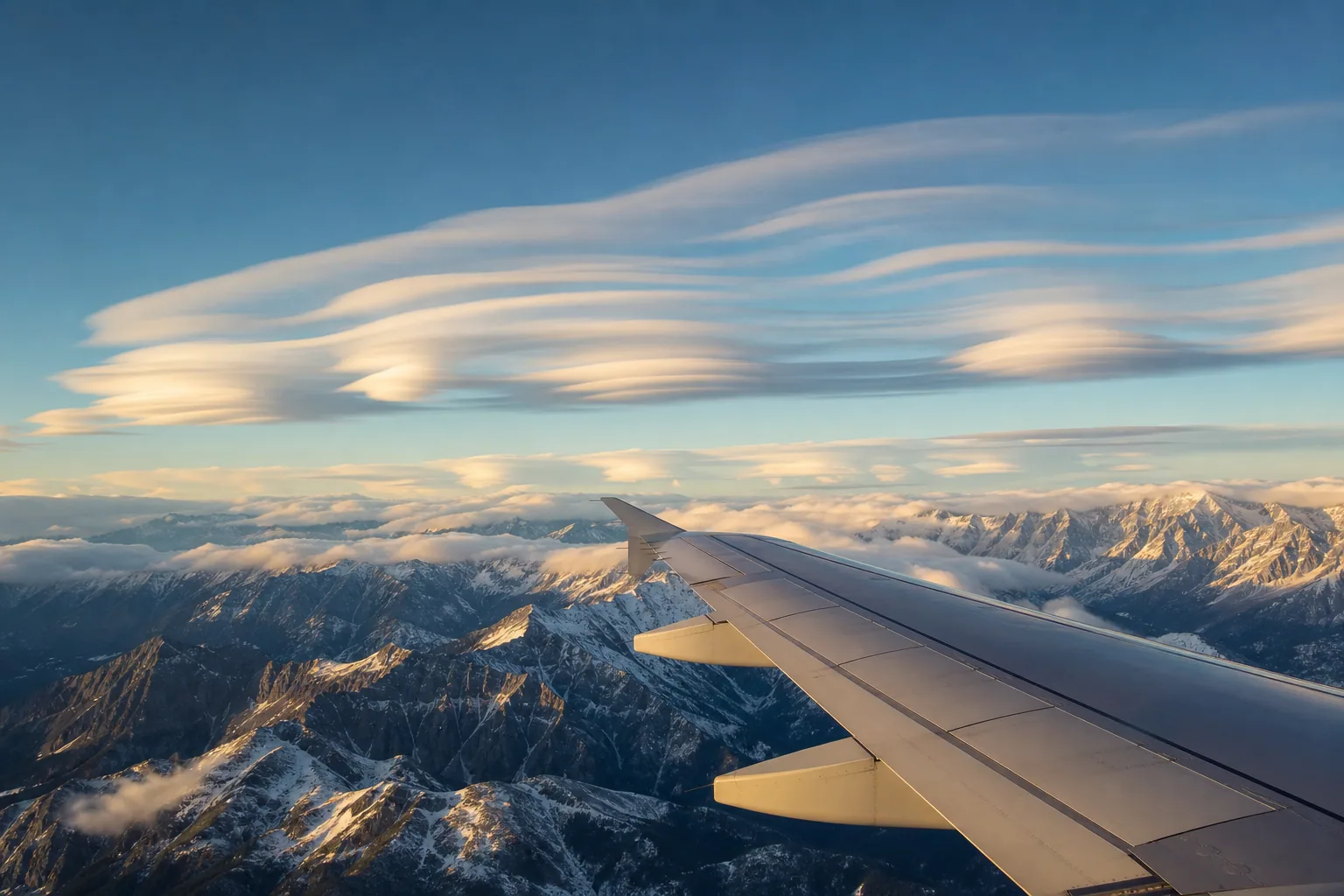
Air turbulence is irregular atmospheric motion that makes an aircraft move through changing currents of air. It can be created by jet-stream wind shear, thunderstorms, mountain waves, weather fronts, surface heating, or the wake of another aircraft. Most encounters are light and brief; forecasts help crews reduce exposure, but no forecast can locate every bump.
Air turbulence is not a hole in the sky or a sign that an aircraft has lost its ability to fly. The wings continue producing lift while the surrounding air changes speed or direction. The cabin reveals the aircraft's response as vibration, a roll, a small change in altitude, or a short rise or fall in the force you feel through the seat.
What turbulence feels like inside the cabin
A passenger feels acceleration, not the invisible airflow itself. A fast-moving but steady aircraft can feel perfectly calm, while a small change in vertical motion can feel dramatic. The rear cabin may amplify pitching movement because it is farther from the aircraft's center of gravity; a seat near the wings often feels steadier, although it cannot remove turbulence.
Little or no noticeable movement.
Keep the belt comfortably fastened while seated.
Small, irregular bumps; liquids may ripple.
Walking can be less comfortable. Follow the seatbelt sign.
More definite movement; unsecured items may shift.
Remain seated and secured. Cabin service may stop.
Large, abrupt movement and difficulty controlling loose objects.
Crews avoid known areas and secure the cabin early when possible.
1. Clear-air turbulence and the jet stream
Clear-air turbulence (CAT) often forms near cruising altitude where adjacent air masses move at different speeds or directions. The strongest horizontal and vertical wind shear is frequently found near jet-stream boundaries, upper-level troughs, and regions where the jet accelerates or curves. Because CAT may exist without a visible cloud, crews use forecast guidance, air-traffic information, and reports from aircraft already in the area.
A jet stream on a map does not mean the entire region will be turbulent. Risk depends on the wind gradient, atmospheric stability, altitude, and the aircraft's exact track through the feature. This is why a useful turbulence map must show uncertainty rather than paint a whole corridor as rough.
2. Thunderstorms and convective turbulence
A thunderstorm is a deep convective system with powerful updrafts, downdrafts, precipitation, lightning, and rapidly changing wind. Airline crews use onboard weather radar, dispatch information, air-traffic-control routing, and official convective advisories to remain clear of hazardous cells. The important passenger distinction is that a route line crossing a broad advisory area does not prove the aircraft will enter a storm; operational routes are commonly adjusted around active cells.
Turbulence can also occur outside the visible cloud, especially near strong outflow boundaries or developing convection. Forecast timing matters because thunderstorms evolve quickly. A route checked near boarding can look different from the same route viewed the previous day.
3. Mountain waves and terrain-driven airflow
When stable, strong wind crosses a mountain range, the air can oscillate downstream like water moving over a submerged obstacle. These mountain waves may extend far above the peaks and well beyond the ridge. Smooth, strong rising or sinking air can exist in one layer while breaking waves and rotor circulation create turbulence in another.
Terrain risk therefore depends on wind direction, wind speed, stability, altitude, and the route's position relative to the range. A mountain on the map alone is not a forecast. Pilots may improve the ride by changing altitude or track when operational conditions permit.
4. Weather fronts, wind shear, and changing air masses
Fronts separate air masses with different temperature, density, and moisture. The associated wind shifts and vertical motion can produce turbulence during climb, cruise, or descent. Near airports, low-level wind shear can be more operationally important than the bumps felt at cruise, which is why takeoff and landing conditions are assessed separately from the route.
5. Thermal turbulence near the ground
Sun-heated ground warms pockets of air that rise through cooler surroundings. These thermals are common over land on sunny afternoons and can create light, choppy movement during climb or descent. Pavement, dry fields, hills, and clouds can change where rising and sinking currents form. The ride often becomes steadier after the aircraft climbs above the active mixing layer.
6. Wake turbulence from another aircraft
Every aircraft producing lift creates wingtip vortices. The strongest wake is associated with a heavy, clean, slow aircraft, especially near takeoff and landing. Air-traffic-control separation rules account for wake categories, and pilots use established procedures when departing or landing behind other aircraft. Wake turbulence is different from broad weather turbulence: it is localized, aircraft-generated airflow.
How pilots know turbulence may be ahead
No single product answers the question. A professional picture combines complementary signals:
- Numerical weather guidance estimates upper-level wind, stability, convection, and turbulence potential at different altitudes.
- SIGMETs and G-AIRMETs identify significant weather areas, but an advisory polygon is not an exact ride prediction.
- Pilot reports (PIREPs and AIREPs) describe what another crew encountered at a time, location, altitude, and aircraft type.
- Onboard weather radar helps crews evaluate precipitation and convective structure; it does not directly reveal every form of clear-air turbulence.
- Airport observations and forecasts describe conditions near takeoff and landing, not the whole cruise route.
CheckFlightComfort combines these categories into a passenger-facing outlook and keeps forecast confidence separate from the comfort score. That separation matters: a calm-looking result built from limited coverage should not appear as certain as a well-supported result.
Can pilots avoid turbulence?
Often they can reduce exposure by changing altitude, modifying the route, slowing to the appropriate turbulence penetration speed, or coordinating with dispatch and air traffic control. The smoothest altitude for one aircraft may not be available because of traffic, fuel, winds, or airspace. A pilot report that helps a following aircraft change altitude is useful even though it cannot guarantee a completely smooth ride. Read the full guide to how pilots anticipate and respond to turbulence.
Is turbulence dangerous?
For passengers, the most practical risk is being unrestrained when an unexpected jolt occurs. Modern transport aircraft are certificated for structural loads that exceed ordinary operating encounters, and crews are trained to manage turbulence. The cabin may feel dramatic long before the aircraft is near its structural limits. Keeping the seatbelt comfortably fastened while seated is the simplest protection against an abrupt bump.
How far ahead can air turbulence be forecast?
Broad atmospheric patterns can be visible several days ahead, but a passenger-specific route outlook becomes more useful as the departure time approaches. Exact routing, altitude, thunderstorms, and pilot reports can change. For this reason, CheckFlightComfort focuses its interactive checker on today and tomorrow, explains the available lead time, and recommends a fresh check closer to boarding. Read how turbulence forecast accuracy changes with lead time.
Frequently asked questions about air turbulence
Can turbulence make an airplane fall out of the sky?
Turbulence can change an aircraft's motion and altitude, but it does not switch off lift or make a modern airliner simply fall. Crews maintain control, adjust speed or altitude when appropriate, and avoid known severe weather areas.
Can pilots see turbulence before they reach it?
They can identify many risk areas through forecasts, advisories, radar, and reports from other aircraft. Clear-air turbulence may occur without a visible cloud, so not every bump can be detected in advance.
Where is the smoothest place to sit?
Seats near the wings are closer to the aircraft's center of lift and often feel less pitching movement than the tail. They do not change the atmospheric conditions affecting the aircraft.
Why can one aircraft report bumps while another does not?
The aircraft may be at a different altitude, on a slightly different route, or have different size and loading. Turbulence also changes with time, so a pilot report is evidence, not a guarantee.
Primary references: NOAA Aviation Weather Center, FAA Aeronautical Information Manual, and FAA Pilot's Handbook of Aeronautical Knowledge. Operational decisions always belong to the airline, dispatchers, air traffic control, and flight crew.